
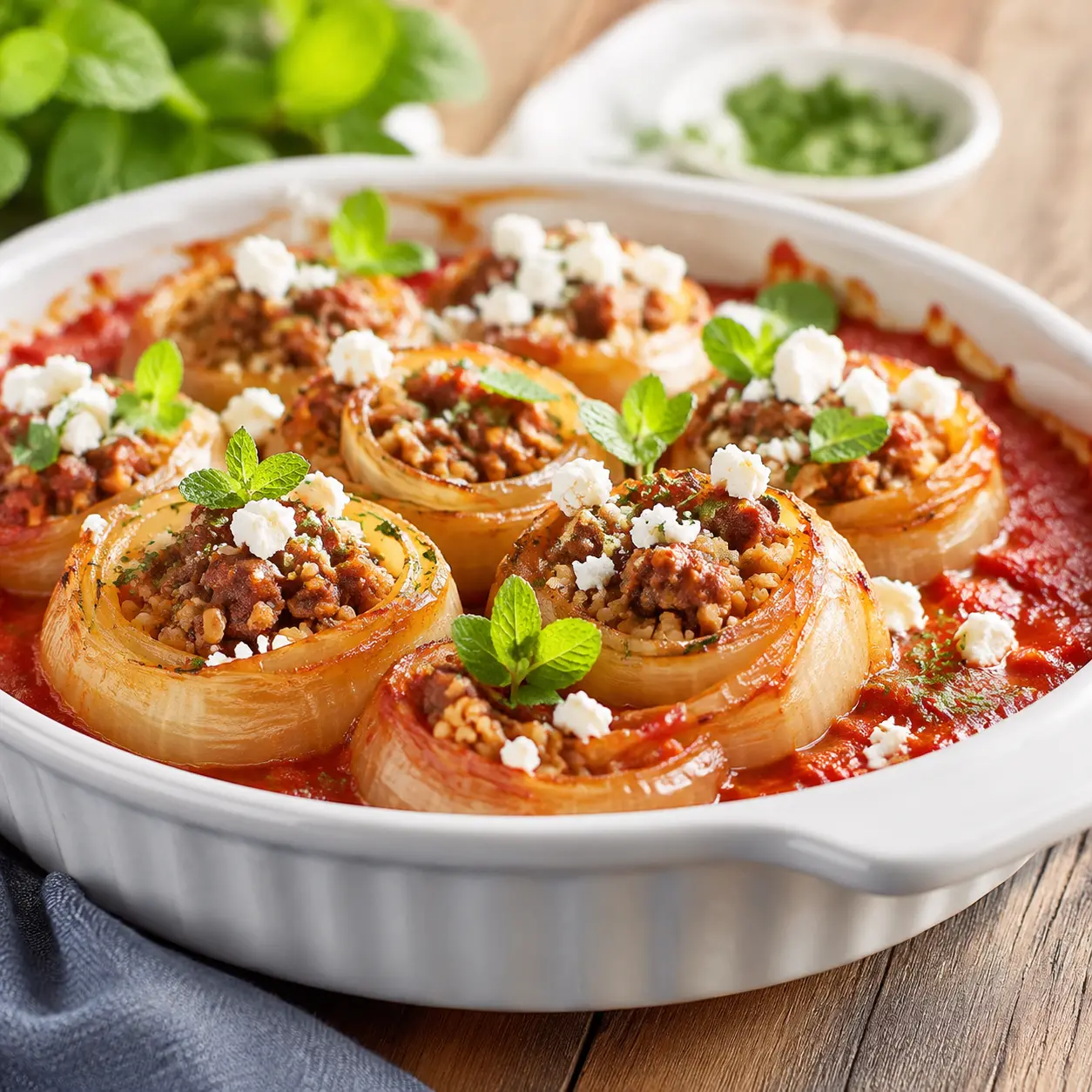
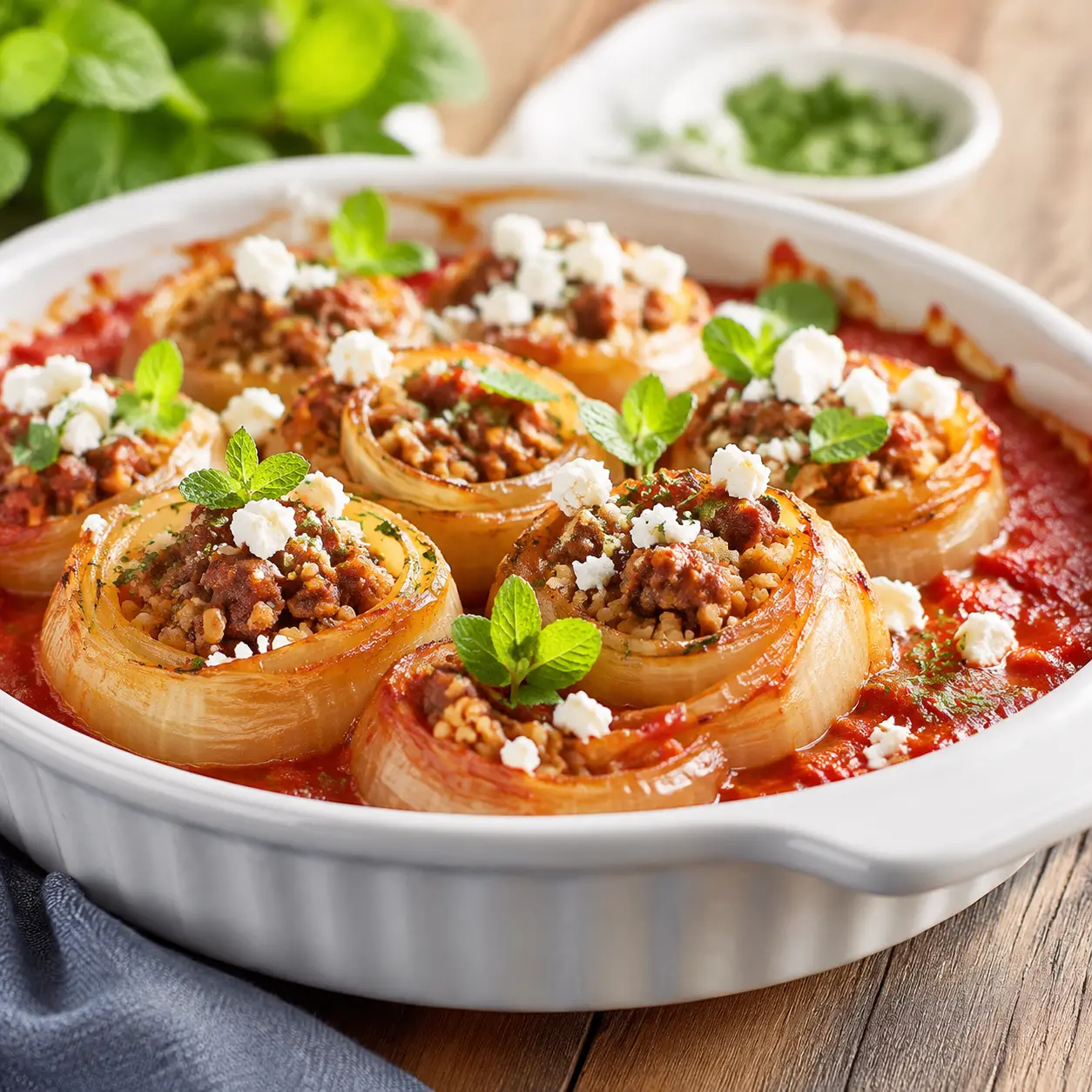
Greek Stuffed Onions with Beef, Rice, and Feta
Ingredients
Method
- Preheat the oven to 375°F and position a rack in the center.
- Bring a large pot of salted water to a boil. Trim the root and stem ends off the onions, remove the skins, and cut a slit down one side of each so the layers can open flat. Boil until the onions are softened, 10 to 15 minutes, reserving the broth. When cool enough to handle, separate the large outer leaves, about 3 to 4 per onion, and save the inner centers for the sauce.
- Heat the olive oil in a wide skillet over medium heat. Add the chopped onion and cook, stirring often, until translucent, about 5 minutes. Add the garlic and cook until fragrant, 1 to 2 minutes.
- Increase the heat to medium-high and add the ground chuck. Cook, breaking it up with a spoon, until browned. Season with salt and pepper. Stir in the crushed tomatoes and bring to a simmer; cook until the sauce thickens slightly. Add the arborio rice and stir well to coat the grains.
- Remove the skillet from the heat. Fold in the oregano, parsley, mint, and feta. Taste and adjust the salt and pepper.
- Place 1 to 2 tablespoons of filling in the center of an onion leaf and roll it up like a shell, tucking the ends if possible. Arrange the rolls seam side down in a 9x13-inch baking dish, packed close together so they stay closed. You may need a second dish to fit them all.
- In a large bowl or measuring cup, combine the tomato paste, 3 cups of reserved onion broth, and the reserved onion centers. Puree with an immersion blender until smooth. Season with salt and pepper. Pour the sauce over the onions, adding extra hot broth if it does not mostly cover them. Cover the dish tightly with foil.
- Bake covered for 1 hour. Remove the foil and continue baking for 30 minutes, until the sauce has thickened and the onions are caramelized. Broil for a minute or two at the end, watching closely, if you want more color.
- Serve warm with pita and additional feta on the side.
Nutrition
Notes
Tried this recipe?
Let us know how it was!Why This Recipe Works
I’ll never forget my first attempt at Greek stuffed onions. I was so fired up to recreate the dish I’d fallen for at a tiny taverna in Athens. I boiled those onions, maybe too enthusiastically, then tried to peel apart the layers. Total mush. I stood over the pot holding a slotted spoon full of onion confetti, wondering where exactly I’d gone wrong.
Turns out, the technique matters more than any single ingredient. Get the parboiling right, handle the leaves gently, and you’re on your way to something that tastes like it came straight from a yiayia’s kitchen. Mess it up, and you’ve got a pot of sad onion soup.
Here’s what makes these Greek stuffed onions so special. The sweet, caramelized onion wrappers hold a savory beef and rice filling packed with fresh herbs and feta. Everything bakes together in a tomato broth made from, get this, the very water you boiled the onions in. No flavor goes to waste.
And they’re a make-ahead dream. You can assemble the entire dish the night before, pour on the sauce, and slide it into the oven when you’re ready. That’s a weeknight win if I’ve ever seen one.
The Origin of Salantourmasi (Greek Stuffed Onions)
In Greece, summer means gemista (yeh-MEES-tah). Tomatoes, peppers, zucchini, and onions hollowed out and filled with herbed rice, sometimes with meat, all baked in olive oil until the whole kitchen smells like a Mediterranean vacation.
Greek stuffed onions go by the name salantourmasi (sah-lan-tour-MAH-see), and they’re the quiet star of that family. You’ll find them in tavernas and home kitchens across Greece, served warm or at room temperature, usually with a hunk of crusty bread to soak up every last drop of sauce. It’s a dish that’s been cooked for generations, yet it still surprises people when it lands on the table.
What I love most is that it isn’t as famous as moussaka or souvlaki. That makes it the perfect dinner party flex. Guaranteed, someone will ask you for the recipe.
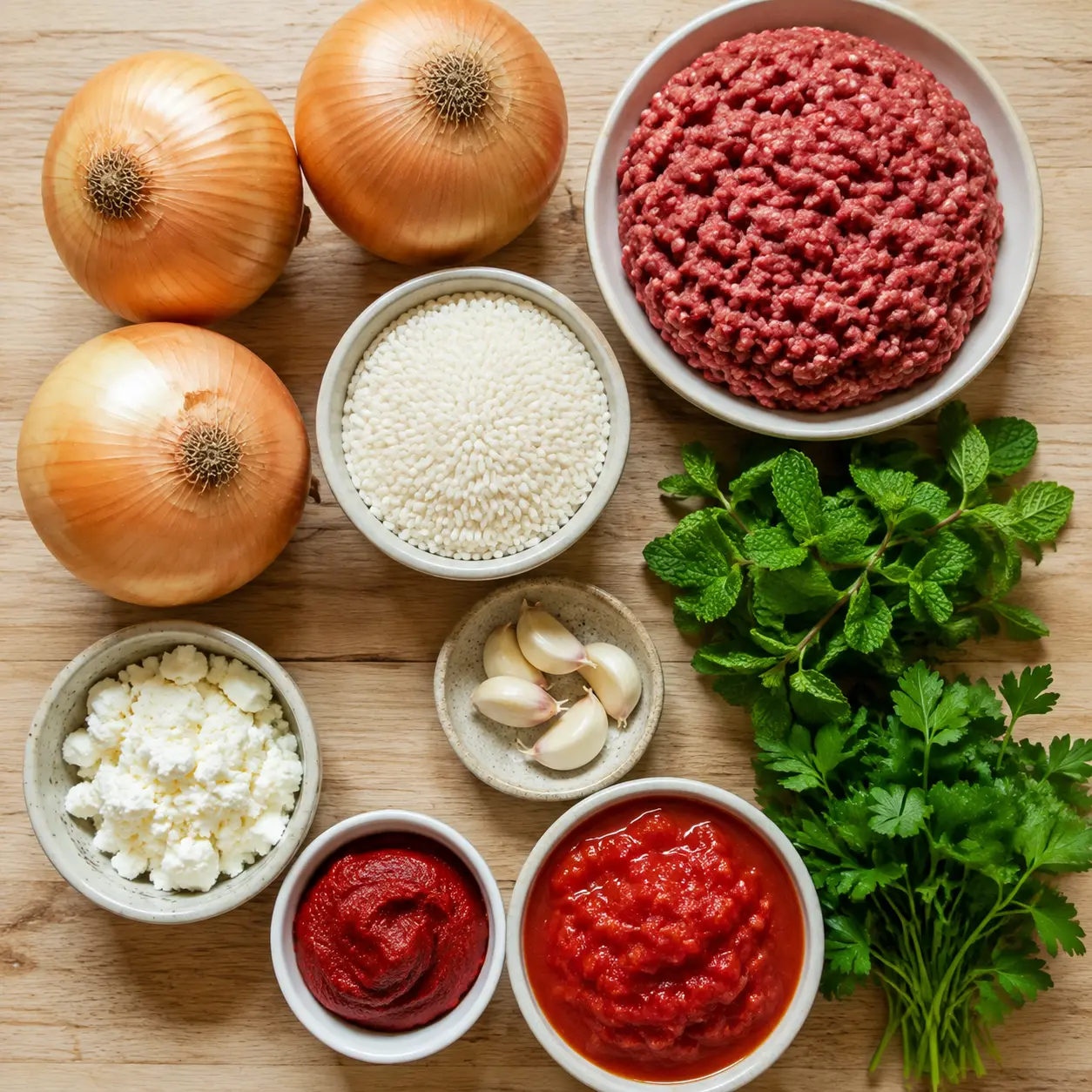
Key Ingredients for Greek Stuffed Onions
This recipe keeps the ingredient list refreshingly simple, which is exactly why quality matters. Let me walk you through the lineup and why each component earns its place.
- Extra-large yellow onions. You want onions at least 10 ounces each. Bigger onions mean bigger leaves, and bigger leaves mean easier rolling. This is the single most important choice you’ll make, so don’t grab the sad little ones.
- Ground chuck. The 80/20 fat ratio keeps the filling moist through the long bake. Ground round or sirloin works if you want leaner, but don’t go too lean or the filling can dry out and turn crumbly.
- Arborio rice. Short-grain rice absorbs the tomato broth beautifully and stays creamy. It’s the same rice you’d use for risotto, and it does something special here, it binds the filling while soaking up flavor.
- Fresh parsley and mint. These two herbs are non-negotiable in my book. They brighten the rich filling and make it taste unmistakably Greek. Dried oregano handles the earthy, savory side.
- Feta cheese. Crumbled into the filling, it melts into little pockets of saltiness that keep every bite interesting. Use a good block of feta, not the pre-crumbled stuff if you can help it.
- Tomato paste and onion broth. The sauce is a genius move. You blend tomato paste with the reserved onion cooking water and the boiled onion centers. The centers puree into a natural thickener, so the sauce turns silky without any flour or cornstarch.
You’ll also want a wide skillet, a 9×13-inch baking dish, and an immersion blender for the sauce. A regular blender works too, just vent the lid and blend in batches.
I usually pick up everything at Ralphs or Trader Joe’s. The onions are the one thing I’m particular about. If you spot jumbo sweet onions at the farmers market, grab them. Vidalia or Walla Walla varieties are at their peak right now, and their natural sweetness makes these Greek stuffed onions even better.
How to Make Greek Stuffed Onions
Okay, this is where the magic happens. I’m going to break this into four stages so you know exactly what to expect at each point. Patience is your friend here, but the payoff is worth every minute.
Stage 1: Parboil the Onions
Bring a big pot of salted water to a rolling boil. Trim the root and stem ends off your onions, peel them, and here’s the crucial part: cut a single slit down one side of each onion. Not in half. A slit. This lets the layers open flat like a book, so you can use them as wrappers. Cutting them in half gives you tiny little boats that are impossible to fill.
Boil them for 10 to 15 minutes. You’ll know they’re ready when the outer layers feel slick and slightly translucent, like silk in warm water. The layers should separate easily when you nudge them with your fingers. Keep that cooking water, seriously, it’s liquid gold for the sauce later.
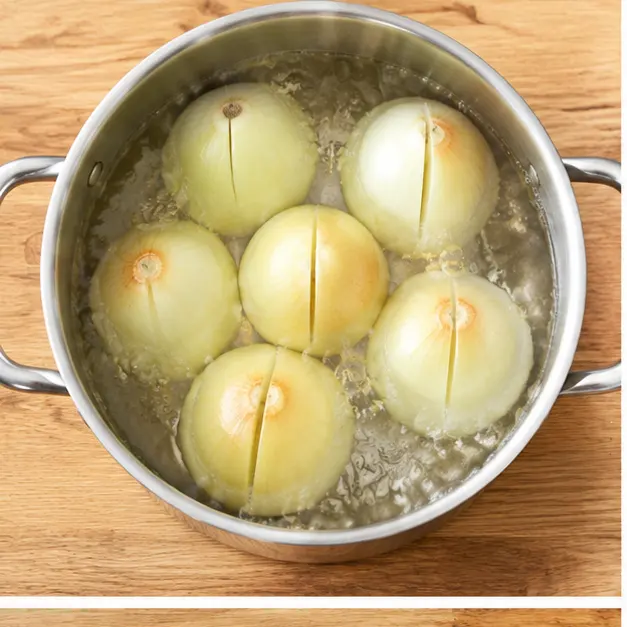
When the onions are cool enough to handle, gently peel off the large outer leaves, about 3 to 4 per onion. Set those aside on a plate. The inner centers? Don’t toss them. They’re going straight into the sauce.
Stage 2: Cook the Filling
While the onions cool, heat olive oil in a wide skillet over medium heat. Add one finely chopped onion and cook, stirring often, until translucent, about 5 minutes. Then add the garlic and cook until fragrant, just a minute or two. Your kitchen is already starting to smell good.
Crank the heat to medium-high and add the ground chuck. Break it up with a spoon as it browns, letting it get some color. Season with salt and pepper, then stir in the crushed tomatoes. Let everything simmer until the sauce thickens slightly. Now add the arborio rice and stir well to coat every grain. This step locks in flavor before the filling even hits the oven.
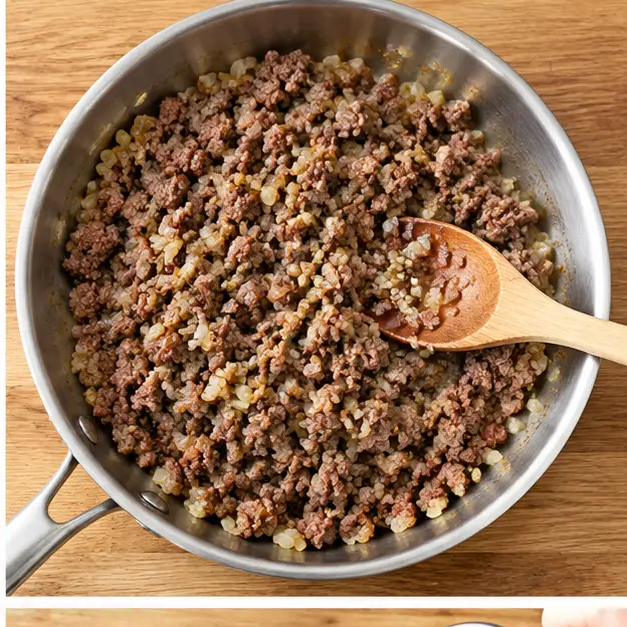
Take the pan off the heat and fold in the oregano, parsley, mint, and feta. Give it a taste. Adjust the salt and pepper. This filling should already be dangerously good, and yes, I’ve definitely eaten a spoonful or two straight from the skillet.
Stage 3: Roll and Assemble
Now for the fun part. Place 1 to 2 tablespoons of filling in the center of each onion leaf and roll it up like a little bundle, tucking the ends in if you can. Don’t overstuff. If the rolls are too fat, they’ll burst open while baking, and you’ll lose all that lovely filling into the sauce.
Arrange the rolls seam side down in a 9×13-inch baking dish, packed close together. The snug fit is what keeps them closed during baking. You might need a second dish depending on the size of your onions, and that’s totally fine.
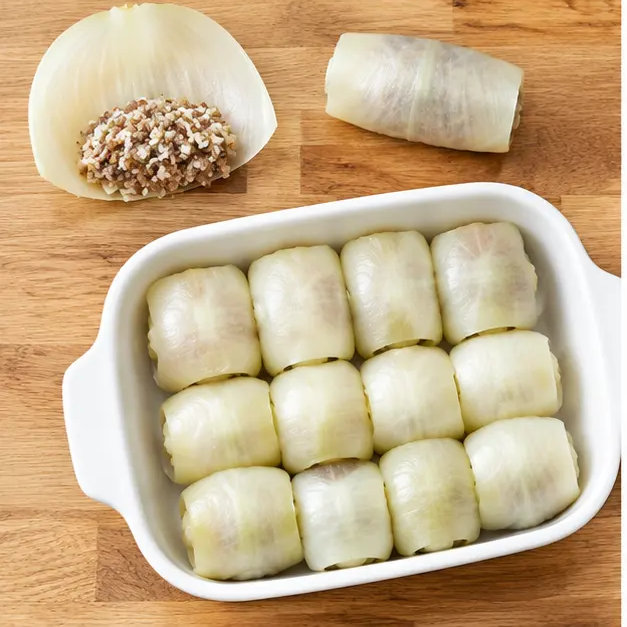
Even Greek yiayiades lose an onion layer now and then. Double-layer it and move on. No one will ever know.
Stage 4: Make the Broth and Bake
In a large measuring cup, combine the tomato paste, 3 cups of that reserved onion broth, and the boiled onion centers. Puree it with an immersion blender until completely smooth. Season with salt and pepper. Pour the sauce over the rolls, it should mostly cover them. If it doesn’t, add a little extra hot broth.
Cover the dish tightly with foil and bake at 375°F for a full hour. Then remove the foil and bake for another 30 minutes until the sauce has thickened and the onions are caramelized at the edges. If you want extra color on top, hit the broiler for a minute or two at the end. Watch it closely. Broilers are unforgiving.
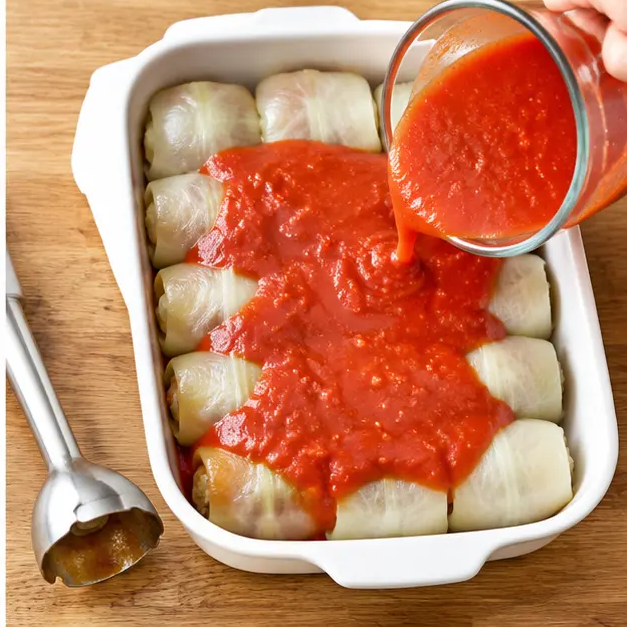
The kitchen will smell like caramelizing onions and oregano, which is honestly dangerous if you’re hungry. Give the dish a few minutes to settle before serving, if you can wait that long.
Expert Tips for Perfect Stuffed Onions
I’ve made this dish enough times to know exactly where things go sideways. Here are the fixes for the most common issues, plus a few tricks that make the whole process smoother.
- Don’t cut the onions in half. A single slit down one side is all you need. It keeps the layers big enough to wrap the filling properly.
- Don’t toss the cooking water or centers. They’re the backbone of the sauce. This is the trick that makes the dish taste like a taverna made it.
- Don’t undercook the onions. If the leaves are stiff, they’ll tear when you roll them. Boil until slick and pliable, the full 15 minutes if needed.
- Do pack the rolls tightly. They hold their shape better, and the sauce has less room to evaporate during that long bake.
- Do taste the filling before rolling. This is your only chance to adjust the seasoning, so trust your palate.
Troubleshooting
Onions tearing: Be gentler, or give them a few more minutes in the boiling water until they separate easily. A torn layer can be doubled up with another leaf.
Filling too dry: You probably used extra-lean beef or overbaked. Stick with ground chuck and peek at the dish around the 1-hour mark.
Onions too tough: They needed more time in the water. Next round, give them the full 15 minutes before you even try to separate the layers.
Variations and Substitutions
The beauty of Greek stuffed onions is how adaptable they are. Here are some swaps I’ve tried and genuinely loved.
- Ground lamb or turkey. Lamb adds a richness that feels very traditional in Greek cooking. Turkey keeps things lighter. Both work beautifully with the same seasoning blend.
- Long-grain rice. If you don’t have arborio, long-grain rice is a fine stand-in. Just avoid jasmine or basmati, their aromatics are too perfumey and distract from the dish.
- Vegetarian stuffed onions. Skip the meat and double the rice and herbs. Add extra feta if you’re not dairy-free. It’s a wonderful meatless main that still feels hearty.
- Sweet onions. Vidalia or Walla Walla onions are incredible here, especially in late summer when they’re at their absolute sweetest.
- A sweeter note. Some Greek versions add a handful of black currants to the filling. It’s an optional touch, but the little bursts of sweetness are lovely against the savory beef.
- Kasseri cheese. Swap the feta for Kasseri if you want a milder, meltier cheese in the filling. It’s a nice change of pace.
For a vegan take, you can make the filling with rice, herbs, and a generous drizzle of olive oil in place of the beef and feta. It’s not the same dish, but it’s a delicious one in its own right and worth making when you want something lighter.
Storage and Reheating
These Greek stuffed onions are one of those dishes that honestly tastes even better the next day. The flavors meld overnight in a way that’s hard to describe but impossible to miss.
- Refrigerate: Keep leftovers in an airtight container for up to 3 days.
- Freeze: They freeze beautifully for up to 3 months. Store with plenty of sauce in a freezer-safe container.
- Reheat: Covered at 350°F until hot, about 20 to 25 minutes. Add a splash of broth if the sauce looks dry.
You can also assemble the whole dish, sauce included, and refrigerate it overnight before baking. Just add about 10 minutes to the covered bake time since you’re starting from cold. That makes it a perfect make-ahead Greek recipe for busy weeks or dinner parties.
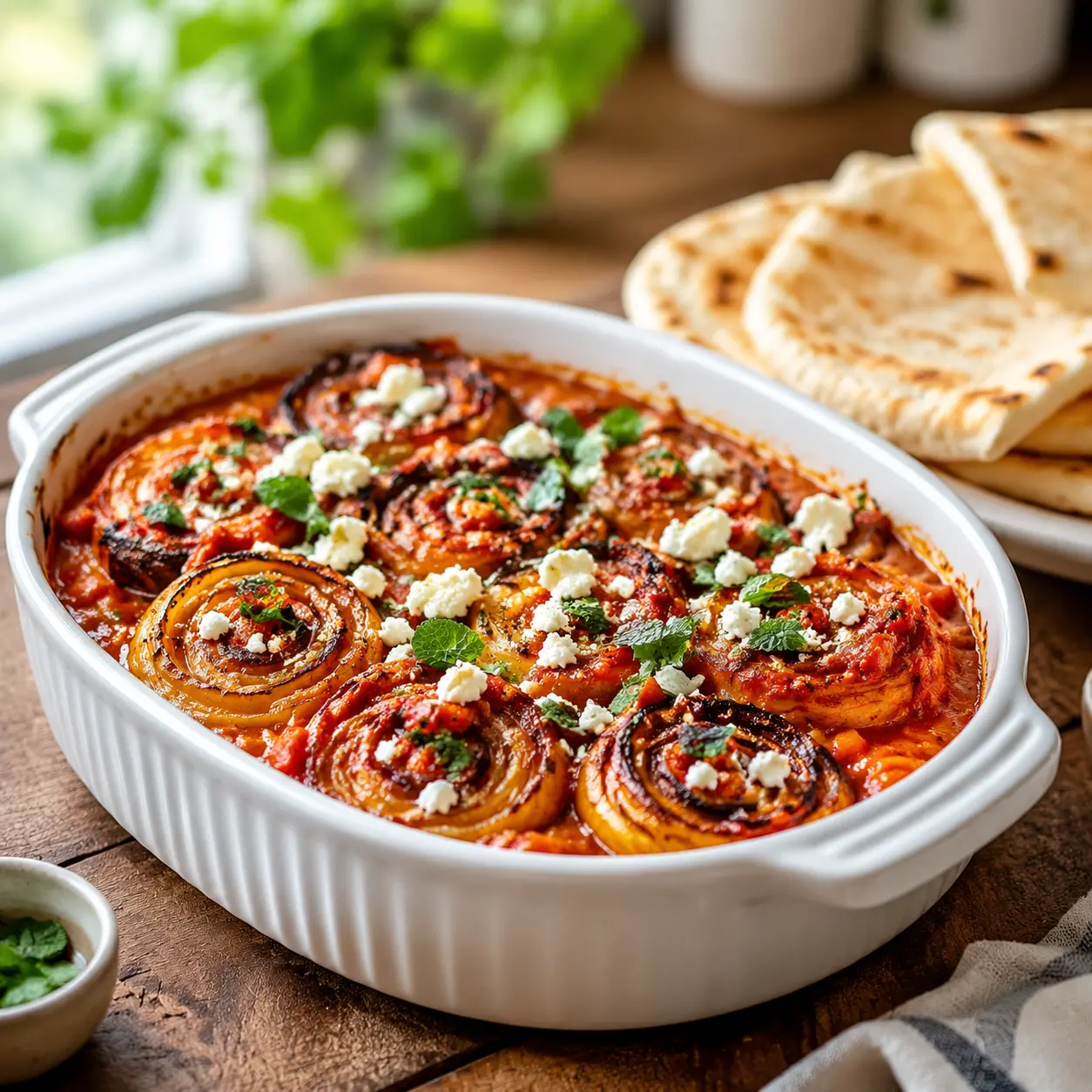
Serving Suggestions
Summer is the season for this dish, and I love serving it the way Greek tavernas do. Warm, with a pile of pita on the table and extra feta for crumbling over the top. The combination of tender onion, herby filling, and that rich tomato broth is pure Mediterranean comfort food.
It also shines at room temperature, which makes it perfect for a casual backyard dinner in August. Set the baking dish right on the table, let everyone help themselves, and watch the platter disappear before you’ve even sat down.
For sides, a simple Greek salad with cucumbers, tomatoes, and olives is all you need. Or keep it minimal with crusty bread for the sauce. Honestly, the sauce is the part people will be fighting over, so bring extra bread.
If you’re hosting, this can absolutely be the main event. The rolls are substantial enough that four per person is a satisfying serving, especially with bread and salad on the side.
Frequently Asked Questions
Ready to Make Greek Stuffed Onions?
This is one of those dishes that looks far more impressive than the effort it actually takes. The onions are the only finicky part, and honestly, once you feel that first perfect layer slide off in your hand, you’ll be hooked on the whole process.
If you make these Greek stuffed onions, I’d love to see how they turn out. I share recipes and tons of Mediterranean inspiration over on my Pinterest board, come say hi and show me your creation.
When you serve this, watch how fast the platter empties. People will go quiet for a second, then someone will say wow. That’s the moment it all becomes worth it.
Source: Learn More About This Dish
How long should I boil onions for stuffed onions?
Boil them for 10 to 15 minutes in salted water. You’re looking for the outer layers to feel slick and translucent, like silk. Test one at the 10-minute mark, if the layers don’t separate easily, give them a few more minutes.
What are the ingredients in Greek stuffed onions?
Extra-large yellow onions, ground chuck, arborio rice, garlic, crushed tomatoes, fresh parsley and mint, dried oregano, and feta. The tomato broth uses tomato paste, reserved onion cooking water, and pureed onion centers.
What is the best sauce for stuffed onions?
For this recipe, the tomato broth made from tomato paste, onion cooking water, and blended onion centers is the way to go. It’s savory, naturally sweet, and silky. If you prefer, avgolemono (av-go-LEH-mo-no), a lemon-egg sauce, is another traditional Greek option.
What is salantourmasi?
Salantourmasi (sah-lan-tour-MAH-see) is the Greek name for stuffed onions, part of the gemista family of stuffed vegetables. It’s a taverna staple that rarely appears on menus outside Greece, which is exactly why making it at home feels like a secret worth sharing.
What’s the difference between a white or yellow onion?
White onions are sharper and more pungent, while yellow onions have a sweeter, balanced flavor that deepens beautifully during cooking. For Greek stuffed onions, yellow is the classic choice because it softens into mellow, sweet layers.
Are salantourmasi healthy?
Yes, made with ground beef, rice, and plenty of herbs, they’re a balanced meal. Each serving has about 675 calories and 30 grams of protein. Use ground sirloin or turkey to lighten things up further.